
Have you ever wondered how a snowflake forms? Very high in the air water droplets freeze onto dust or pollen particles. What is created is an ice crystal. The snowflake then falls to the ground. Snowflakes are always symmetrical, meaning the right and left sides match. You may be wondering why they form into such exotic patterns. It is because the water arranges itself like tiny water molecules. That is why no two snowflakes are the same. Every snowflake is different. What a creative God we have!
Here’s a fun fact. Longer, more needle-like snowflakes are a result of warmer temperatures. And more flat-looking ones form in colder temps. A snowflake’s shape can be due to how it falls and what conditions are like. But one thing that always stays the same no matter what is that a snowflake will always have six sides. This means that if you see a snowflake that doesn’t have six sides, it is not real. Yet there is one exception. When two snowflakes start to grow together, they can produce a 12-sided snowflake.
Here’s a picture from the web. As you can see, some of the points on the snowflake are smaller than others. They follow a pattern. You can see where one snowflake joined the other—the smaller spokes belong to one snowflake and the larger spokes to the other.
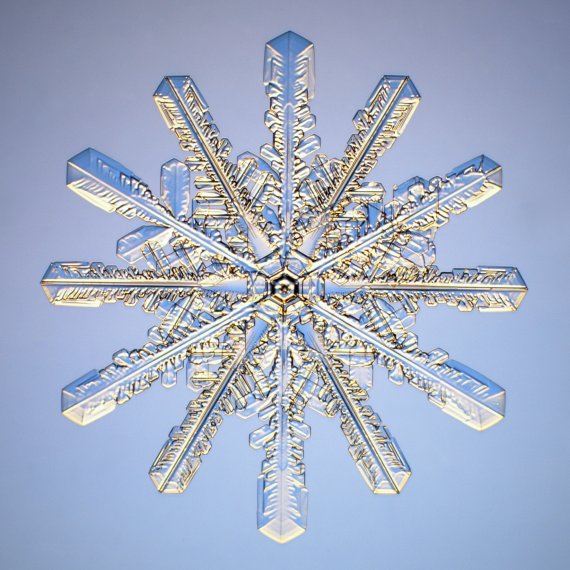
Twelve-sided snowflakes are very rare, but if you look closely the next time it snows, you might find one!